Who governs the intelligence?
The Plural AI Stack Assessment
An open, evidence-graded scorecard of power concentration across the AI value chain. Not what a model says: who controls the stack that says it. Every verdict traces to a dated, permalinked piece of evidence. Every gap becomes a published question. From Phase 1, every provider gets a gap list and a right of reply.
Europe legislated the assessment. Nobody built the instrument.
On 3 June 2026 the European Commission tabled the Cloud and AI Development Act. It obliges public bodies to assess cloud and AI services against four sovereignty assurance levels, from EU data residency to demonstrated independence and EU control. The Act defines the levels. It does not define how anyone establishes them.
Europe now has a four-tier assessment and no methodology to run it. The Plural AI Stack Assessment is that methodology.
Access revocation
12 June 2026. A US export directive cuts foreign users off from Anthropic's newest models; to comply, Anthropic switches them off for every customer worldwide, for 19 days. One government order, one global kill-switch.
The knowledge siphon
12 July 2026. Satya Nadella's "Reverse Information Paradox": buyers pay for intelligence twice, as their expertise flows back to the provider trace by trace.
Interoperability by order
16 July 2026. The Commission's DMA decision obliges Google to open Android assistant access and share search data with rival chatbots. Since 2 August 2026, the AI Office can enforce the AI Act's Art. 53 training-data obligations, in force since August 2025.
Auditors wanted
6 September 2026. OpenAI's chief scientist concedes that no lab has solved alignment, asks for safety bars enforced by third-party auditors and names the goal: prevent extreme concentration of power. A frontier lab asks for the auditor. Nobody yet measures the concentration.
Disclosure without a ruler
August 2026. One year into AI Act Art. 53, a comparison of eleven training-data summaries finds three providers replacing the official template with prose and almost every provider reporting "more than 10 trillion tokens". The law demands disclosure. Nobody can compare it.
Sovereignty, layer by layer
September 2026. Ministers from nineteen member states sign the IPCEI-AI manifesto: a European AI stack across the entire value chain, with more than €10 billion in expected investment. How sovereign will it be?
Existing scorecards answer important but incomplete questions.
No existing assessment asks questions about the whole value chain: who owns the specifications, who can exit and how, who captures the value, and who has a voice. That is the question the Plural AI Stack Assessment is built to answer, with verdicts a provider cannot buy back with strength elsewhere.
Existing Assessments
Transparency indices
Stanford's Foundation Model Transparency Index grades what a developer discloses. A firm can be maximally transparent about a maximally concentrated architecture and score 95 out of 100.
Openness frameworks
The Model Openness Framework (LF AI & Data) stops at the model artefact: weights, code, data cards. Nothing on inference access, the usage-data loop or who owns the evals.
Safety and pluralism scorecards
FLI AI Safety Index, SaferAI, and AI Pluralism Index all ask whether a model is safe or whose voice shaped it, and they average: strength in one pillar offsets capture in another.
Measure structure, not statements.
The Plural Stack paper defines what a plural digital system looks like. The assessment turns it into an instrument.
✦ Tier 1: the gate.
Ownership · Multiplicity · Permissionless Entry · True Interoperability. Result: PROTOCOL or PLATFORM. A platform is flagged, never excluded; it still receives the full scoring. The flag tells the reader what kind of thing they are looking at.
✦ Tier 2: sixteen properties, 89 indicators.
Each indicator is an observable fact with a named evidence source and a fallback question if it cannot be resolved from the outside.
✦ Twelve emergent outcomes.
Credible neutrality, composability, agency, democratic legitimacy and the other eight are recorded against the foundations that should produce them. Outcomes without foundations are what the paper calls claims without foundation.
Three dimensions. One verdict per property.
Every property gets its own verdict: Plural · Partial · Centralised, or Insufficient Evidence when coverage is below threshold. Non-compensatory: strength in governance does not repair extraction in economics. Inconclusive is reported, never scored as a fail.
Technical
- Open-source code
- Decentralised architecture
- Informational congruency
- Interoperable open standards
- Privacy by design
- Secure and verifiable execution
- Auditability
Economic
- Non-extractive value distribution
- Transparent economics
- Purposeful public funding
- Data dignity (data as labour)
Social
- Participatory governance
- Bridging deliberation
- Generative openness
- Social provenance transparency
- Right to exit and fork
Outside-in, in four steps.
Only publicly observable evidence. No code review, no contract access, no provider cooperation required. The method is written so a third party can run it without us in the room.
1 · Scope and gate
Define the service boundary, the provider chain and the position in the stack. Run the Tier-1 gate.
2 · Evidence sweep
Harvest across 17 source classes: specs and repos, terms-of-service history, court and regulatory records, governance minutes, OSS-community conduct, user voice, ownership filings, and, from Phase 1, the assessor's own hands-on probes.
3 · Verdict and gap list
Score per indicator, property and dimension. Every unresolved indicator becomes a precise question to the right addressee: provider, community, regulator.
4 · Integrity gate and publication
The Completeness and Robustness Index checks coverage, robustness and the emergent check before anything publishes. From Phase 1, providers receive the draft 14 days ahead and their reply is published unedited alongside. Every scorecard is a dated snapshot; licence, ToS, Art. 53 or DMA triggers start a delta re-assessment, never a silent edit.
Seven pilots. The instrument discriminates.
Seven services, one procedure, around 370 permalinked evidence rows. The spread is the point: an instrument that cannot tell Ethereum from WhatsApp is not measuring anything.
All seven are provisional. They were scored by one assessor with AI-assisted evidence sweeps and human verdicts; second-rater review, executed hands-on probes and provider replies are what Phase 1 adds. We publish them now so the method can be criticised on the record, not so the numbers can be quoted as final. Counts are properties out of sixteen: Plural · Partial · Centralised · Insufficient Evidence.
Ethereum
Protocol ecosystem · Gate: PROTOCOL
9 · 6 · 0 · 1 · Coverage 84.7 %
Matrix
Messaging protocol · Gate: PROTOCOL
5 · 10 · 0 · 1 · Coverage 76.5 %
Bluesky / AT Protocol
Social protocol by design · Gate: PLATFORM
4 · 11 · 0 · 1 · Coverage 83.5 %
Signal
Messaging platform · Gate: PLATFORM
3 · 12 · 0 · 1 · Coverage 80.0 %
Messaging platform · Gate: PLATFORM
0 · 7 · 8 · 1 · Coverage 82.4 %
Claude (Anthropic)
Closed frontier AI · Gate: PLATFORM
0 · 13 · 3 · 0 · Coverage 87.1 %
Gemini (Google)
Closed frontier AI · Gate: PLATFORM
0 · 8 · 8 · 0 · Coverage 90.6 %
The Plural AI Stack Assessment
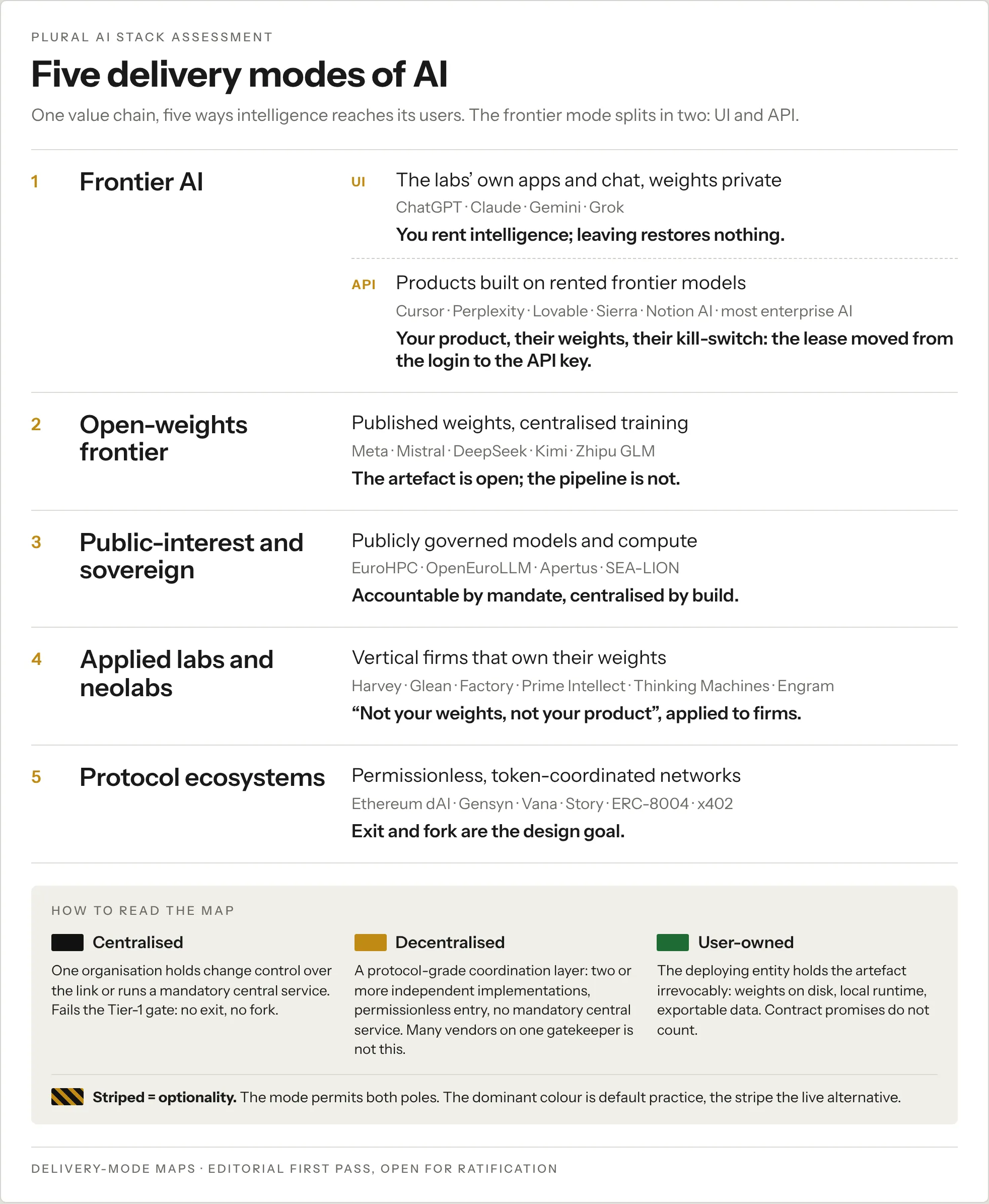
Five delivery modes of AI.
One value chain, five ways intelligence reaches its users. The assessment asks the same question of every field in each mode: who holds it?
Centralised: one organisation controls the field, be it a lab, a vendor or a state agency.
Decentralised: many independent, substitutable actors, no single controller.
User-owned: held by whoever uses or deploys the AI, including weights, data and runtime.
The value chain: who holds each link.
Fourteen links, five delivery modes, read in five stages. This map is an editorial first pass, open for ratification.
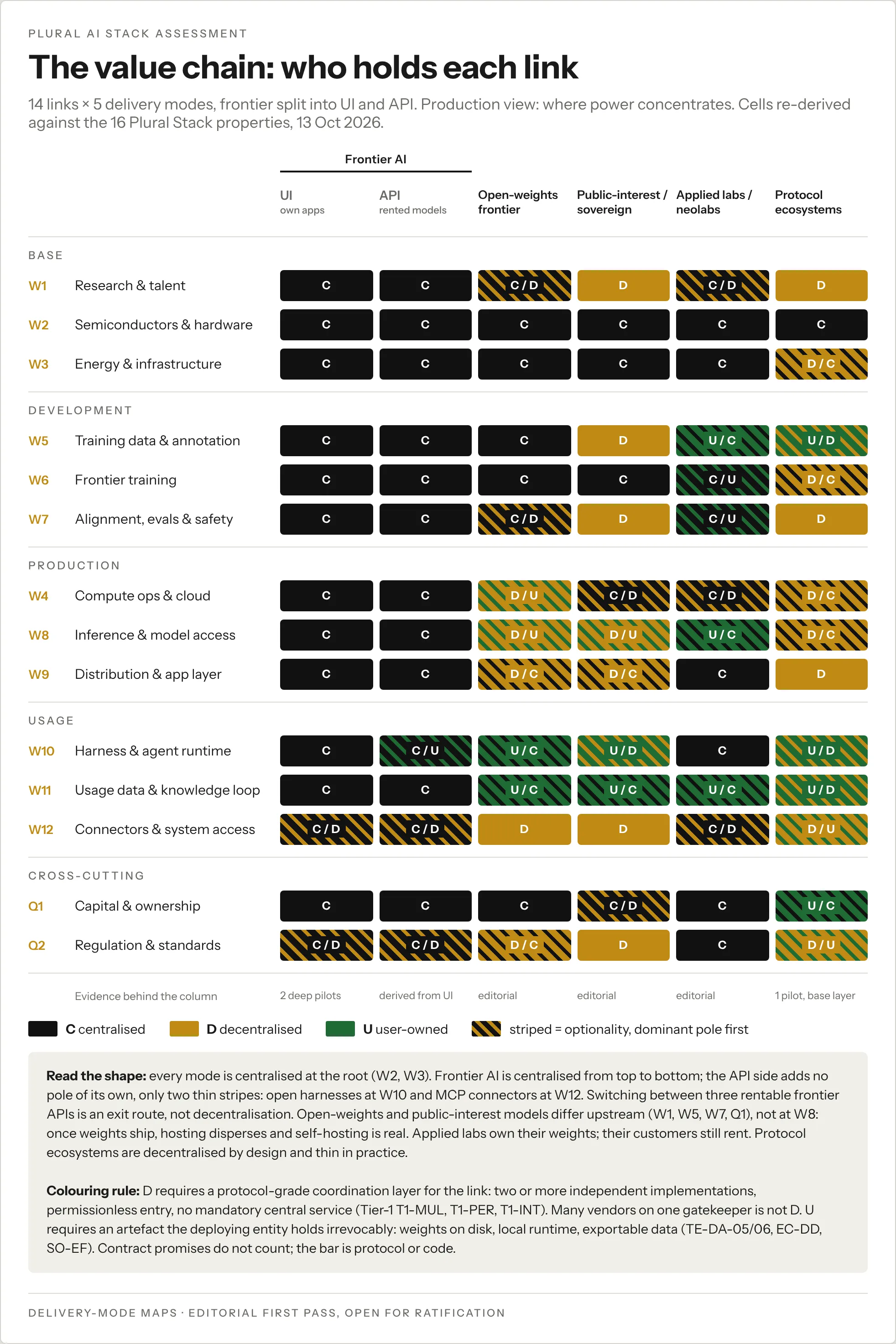
Where capture bites first: the AI value chain.
Version 1 scores AI services and the value chain they are composed of: fourteen links, twelve from research and semiconductors through training, inference and distribution to usage data and connectors, plus two cross-cutting axes. Deep verdicts concentrate where the 2026 evidence says power is captured. The other links stay in scan mode. Nothing is dropped.
W5 · Training data and consent
The consent lever: AI Act Art. 53, in force since August 2025 and enforceable since August 2026. Who was asked, who was paid, who can withdraw.
W7 · Alignment and evals
Who owns the evaluations that decide what counts as safe, and who may verify them.
W8 · Inference and model access
The terms-of-service kill-switch versus open weights: who can revoke access, and to whom.
W11 · Usage data and the knowledge loop
The Reverse Information Paradox: whose expertise compounds where.
Q1 · Capital and ownership
Eight cap tables, one pattern. Every priority link is read through this axis.
Q2 · Regulation and standards
AI Act, DMA, Data Act, CADA: the evidence regulators produce, and the evidence they will need.
Who acts differently because of a verdict.
A citable, reproducible benchmark of concentration versus distribution of power over the AI stack, and a race to the top in which providers close named gaps because being legible is now in their commercial interest.
Public procurement
CADA assurance levels need evidence about ownership, exit and third-country reach. The assessment’s properties map onto the levels; verdicts become procurement-grade inputs. For national buyers, EU institutions, sovereign-cloud programmes.
Regulators and standards bodies
The AI Office reviews training-data summaries; DMA teams verify interoperability orders. Open evidence logs are the independent check.
Journalists and civil society
Today "Big AI concentrates power" is an argument. A dated, permalinked scorecard turns it into evidence that can be quoted, contested and updated.
Providers
Each scorecard ships a gap list: what moves you from Centralised to Partial. Answers are processed as new evidence and re-scored. That is the race to the top.
What we say before a reviewer does.
The assessment has a complete method and, today, thin independent measurement evidence. No inter-rater study yet. No executed hands-on probes yet. The integrity gate has passed all seven pilots, so its thresholds have not been tested against a failure. Verdict anchors are still prose where they should be cut-points.
Phase 1 closes exactly these gaps, with results published either way: a blinded two-assessor study, an external reviewer panel of five, executed probe sets with artefacts under version control, an open repository with a DOI and a correction policy, and a published cost per reviewed assessment.
The instrument's honesty about what it cannot see is the same property that makes it hard to attack.
Fund the Plural AI Stack Assessment
Seven pilots, the catalogue, the validator and the runbook exist with zero grant funding behind them. The counterfactual without funding is that they stay unreviewed, unpublished and unmaintained. The core scope over twelve months turns a validated prototype into a public, reviewed, reproducible benchmark of power over the AI stack. Lead organisation: RadicalxChange Foundation; assessments are published under the Foundation with reviewer sign-off.
Months 1–3 · Validation sprint
Blinded inter-rater study on two services, five-person external reviewer panel, executed probe sets P-01 to P-06, right of reply adopted, open repository with DOI, published cost per reviewed assessment. Three existing AI-stack assessments republished to publication grade.
Months 4–12 · Wave one
Ten AI services on the priority cut, one of every candidate type: closed and open-weight frontier, public-interest, EU and sovereign infrastructure, chokepoint, protocol ecosystem, standards, applied lab. Open dashboard v1, gap lists to providers, the "State of the Plural AI Stack" report and a CADA mapping note.
Months 7–18 · Expanded scope (beyond core)
Coverage to around 20 services including the second open-weight wave; link assessments for training data (W5) and inference access (W8); live watchlist re-scoring on Art. 53 filings, DMA orders, licence and ToS changes; an EU procurement edition with a public buyer as pilot user; crosswalks with the Model Openness Framework and weval.
Are you in?
Four ways to work with the assessment.
Providers
Want your service assessed, or want to answer a gap list? Request an assessment or submit a self-assessment; both are processed as evidence at the next snapshot.
Assessors and reviewers
Measurement methodology, platform and competition law, open-source governance, public procurement, investigative journalism: five seats on the reviewer panel, and training for partner organisations that want to run assessments under the same validator.
Public buyers and regulators
Pilot the CADA mapping with us: which indicators evidence which assurance level.
Funders
Phase 1 is a twelve-month programme under the RadicalxChange Foundation, starting with a three-month validation sprint. The section above has the scope; ask for the proposal.
Read the method.
The Plural AI Stack Assessment operationalises The ⿻ Plural Stack (v1.0, June 2026). Methodology and criteria catalogue are published under CC BY 4.0; public repository and DOI follow in Phase 1.
- Criteria catalogue v0.5: 16 properties, 89 indicators, evidence ceilings, verdict anchors
- Assessment runbook: phases, roles, time budget, source register with 17 classes
- Scorecard packages for the seven pilots: scorecard, evidence log, open questions
- Explainer deck and the known-limitations note (audit of 2 September 2026)
Prefer email? Write to hello@pluralstack.org.